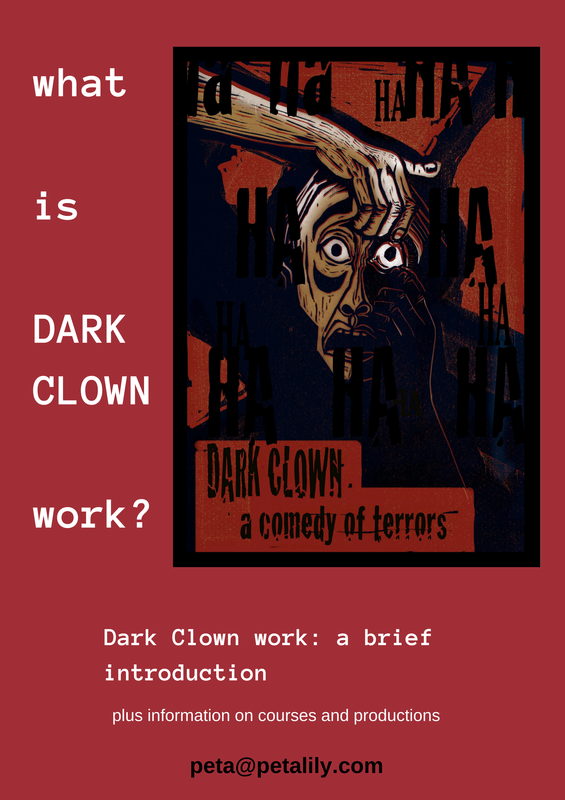
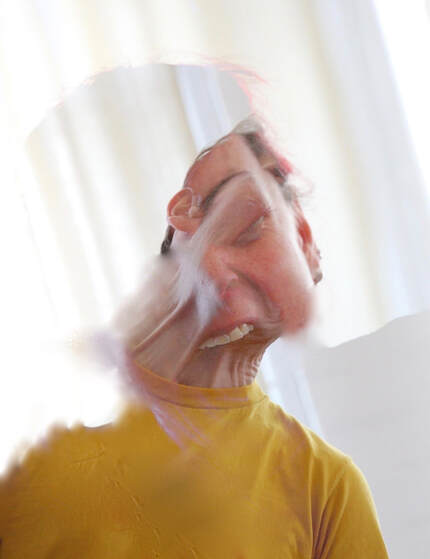
 Photography: Robert Piwko. Collage PL
Trigger warning: genocide
Recently, after I posted a new instalment of this blog, a Clown & Dark Clown 'graduate' wrote to me.
She said:
'I’m extremely excited about the Dark Clown book you are writing. Your workshop is still as vivid as ever in my mind and that was 10 years ago. Since then I’ve been deeply involved in teaching storytelling/theatre-making for social justice, a journey that has led me to Rwanda five times. I took an intensive course, the “Harvard Program in Refugee Trauma” (HPRT) through Harvard’s medical school. The course - which deals with trauma and recovery - had direct ties to storytelling and I needed to know more.
'So much of what I’ve felt, stories I’ve heard - the absurdity behind fear, hatred and violence - has been processed into numerous dark clown scenes in my head ... I found it was useful to do that, just to process the insanity and learn to walk with it. Right now I am working on a Master in Education and I’ve been making loads of connections between teaching and red nose clown work, also. Thank you for your work, it’s left a lasting impression on me and became a tool in my everyday life.' - Ongoing-Learning Educator and Theatre-Maker who focuses on Social Justice Education and Kinesthetic Learning
The Course Participant has asked to remain anonymous – I am going to call her Sandra. The course she attended was set up by a host (Lyndi Smith) and took place in Coventry. 10am – 5pm Monday 12th to 16th April 2010. Just a side note as I look at my files, I see that this was back in the days when I promoted Dark Clown with this description: ‘ A chance to play with a darker kind of humour … an experiment with the edges of laughter … a way to create clown characters and performing ensembles with more edge and relevance … a way to update the sweet and poetic image of the clown … a way to make a more exciting and demanding rapport with audiences ...’
After hearing - in a FB DM exchange - that 'Sandra' found the Dark Clown work helpful to ‘process the insanity’, I was compelled to contact her and we set up a Zoom chat.
When we connected on Zoom, Sandra first spoke about the Clown part of the week-long course. With a photographic memory (or perfect note-taking and subsequent application)* she recalled techniques she learned on the course and now uses regularly, although not under the name of ‘Clown’: e.g. dancing with different parts of your body and the point-and-name exercise which I learned via the wonderful Niall Ashdown. She appreciated the benefits of the work, saying that for her these exercises ‘slowed down time’, enabling greater ability to appreciate how your body is sharing your story and how you are connecting with your audience. She mentioned, too, how memorable the work was – ‘you can’t forget about it and go back to the old ways’.
Sandra said that the Clown & Dark Clown course provided her with ‘a way to look with an innocent eye'** even when in unsettling situations such as looking at the bones of victims in what was Nyamata Church and now is the Nyamata Genocide Memorial Centre.' (Remains are now being stored out of sight).
The Clown's curiosity was helpful too - Sandra found that ‘curiousity diminishes fear’ and felt that this allowed her to simply ’be’ with the Horrific. She said: ‘I was asking myself – how does one respond in order to be with this? And I realised I had prepped for this. Clown work heightens the senses and slows things down and that made it endurable ... listening to the stories people recounted of rape, of being made to dig their own graves. Through the Dark Clown work, I had had the opportunity of experiencing in a safe learning space - a way to imagine and embody humiliation, despair and shame and fear.'
Like me, Sandra appreciates that the response of anger and outrage is the ‘tip of the iceberg’ and that underneath are the Marginalised Emotions*** such as self-loathing and mistrust. These are not emotions anyone would logically choose to experience, but they can remain life-sappingly trapped if one is unwilling to look at them, or, to use Sandra's expression 'walk with them'.
'Through the lens of the Dark Clown work I was able to see the component parts of the situations, examine what I was hearing. The fact that I walked the Dark Clown scenarios helped me stay settled and grounded in the face of absolute darkness and look at my emotions in a curious way. I could see things, too, from a variety of perspectives, see it as theatre and imagine: what would be like as a performer to perform this? What would the victim do in response to the perpetrator’s actions, what would the bystander/onlooker do? And my training at Harvard supported this.’****
I was gratified to hear this, reinforcing my own instincts that being able to Witness the detail in the Desperate Predicaments of the Dark Clown work had a benefit and validity. The aim with the Dark Clown work is that the player is able to pretend well enough so that we in the audience experience the Palpable Cost of contemplating a horrific choice - for example: someone playing in the line-up exercise is given the instruction to decide who in the group will be punished. ***** In the playing of the exercise, the aim is that the audience see: how the prisoner/player looks being given the alarming instruction, their panic/conflict/desperation while considering making the Impossible Choice and then how they look afterwards - experiencing shame and horror that they complied.
We get to see and feel these moments clearly, broken down - as contrasted with, say, a horrific situation being delivered in an opaque chunk (e.g. as one might read or hear the fact that people were forced to select who died and survived). When presented with a ghastly fact / event / news / story, it is natural that the nervous system shies away, retreats. There is aversion and a level of numbness. (We might even feel that it might be morbid to take time to imagine such a thing.)
And as a side note – the audience of the Dark Clown is (via the comedy craft) is encouraged to make a sound – a laugh (albeit a Troubled Laugh) which provides the opportunity for some release as opposed to the hushed reaction ’don’t look’; an alternative to silence, shutdown and holding in.
Sandra further values the contribution of the Red Nose Clown and its 'pulse of empathy'. She mentioned Rwanda's emphasis on forgiveness and reconciliation and that she had encountered perpetrators who had confessed, experienced a process of contrition and who are in the process of making reparations. She found herself in situations with these people and she found that she was able to just be with these people, to humanise not demonise them - to imagine them in the darkest and scariest moments, making the regrettable choices that they made. Sandra said that ‘curiosity and the pulse of empathy had helped me connect to the darkness and joy in another, and learn that in spite of the Horrors, there is common ground: these folks were parents, grandparents, farmers, enjoyed jokes and dancing.’
Sandra also said that Clown & Dark Clown work has also played a part in her own healing (including therapy) from vicarious trauma, accrued over the years (by being able to use the Red Nose Clown’s ability to access joy, to find relief and provide a thinking and feeling space via curiousity). Sandra again mentioned the value of Red Nose Clown providing ways for her to ‘refill’ on compassion (many care workers experience empathy burnout).
Back in the context of my open workshops for theatre practitioners, I shared with her a new practice I have installed on the Clown & Dark Clown course (when I sense it is needed or might be about to become needed). I invite participants to enter Red Nose state and to find a piece of wall or furniture and to comfort it e.g. 'it will be ok, you're doing really well. Yes it's scary but there are still donkeys ...' etc. Sometimes I instruct them to reassure or apologise to the floor and walls: 'I'm sorry you had to see that. It was dark, wasn't it?'
Sandra again expressed her good fortune that fate had led her to the work ten years ago: ‘When else do we get the chance to encounter the Marginalised Emotions except when it happens to us?' In the workshop we have space and are encouraged to have flexibility and are called to employ a shifting viewpoint, and shifting modalities of awareness. She said she felt that the Dark Clown work was ‘bigger than a performance practice – it is a practice for life, giving guidance, a kind of map to navigate the Horrors.’
I currently do not and would not offer the Dark Clown work as anything other than a theatre arts practice although a couple of course participants who were therapists have commented on the value they felt the work offered and mused on its further potential. (It is not a goal I am aiming towards, but perhaps, at some point in the future, the Dark Clown work might find a place as a component contained within a larger training programme led by a care-worker programme or some kind of well-supported teaching or psychological training programme.)
Like me, Sandra saw that this is not work for the already traumatised. They have had the encounter with Horror, they need different help to recover. But it may be possible that for future care-workers, the Dark Clown work may offer valuable benefits.
Meanwhile, there are those of us who, although we have not been as close to experiences of large conflict, are still being remotely affected by world events - in the news, on our Facebook feed and as we walk the streets witnessing people living in destitution. At a daily level, we are not given time to deal with any feelings we might have about dreadful events in this world that we know ourselves to be a part of. *******
Many participants report gratitude for the side benefits of the work:
'I have learned to better recognise how and where these emotions sit in my physical body, to better label and understand their influence on my being. Once labelled and located, they are better explored with the opportunity for release or conscious use to transform. I now have a process allowing me to hold on to what is useful, work through and release what is not.' - Course Participant
I aim to hold the Dark Clown work as ethically as I can. Please do see the helpful FAQ's for the work. The work walks an edge. But, like many theatre practitioners, I have an interest in inner and outer humanity and I feel it is an edge better looked at than ignored. Hence my being gratified that this particular course graduate's felt similarly and articulated her thoughts so generously and well.
For clarity's sake, let me repeat: I currently do not offer the Dark Clown work as anything other than a theatre arts practice. Read more here.
*I took copious notes on my first workshop with Philippe Gaulier and Monika Pagneaux – I was magnetised by the enlivening, mysterious, de-mystifying work these masters were offering and that influence has been enduring, even as I mixed it with other theatre forms and bodies of knowledge.
** one could also say ‘beginners mind’
*** What are the Marginalised Emotions? Imagine a horizontal line. If human expression were expressed as a continuum, you might have joy way over there on the right, and, if we are talking Red Nose Clown, we might have expressions such as silliness, loveliness, pride, bashfulness relatively nearby. As we near the centre of the line there may be grumpiness, crossness, even anger. But what about the other half of the line? Now we are heading for the expressions of the Dark Clown, what I call the Marginalised Emotions – such as: hyper-vigilance, fear, distress, shame, anguish, regret, guilt, humiliation, indignity, disbelief, grief, shock, absurdity, desolation, despair, physical pain, horror, terror and existential dread. (Listed in no special or incremental order).
**** Having had some access to Holocaust training, I avoid any role play focusing on Perpetrator / Victim scenarios. Where there is a player representing a guard, I limit their participation strictly. I say: In this work we are not interested in the Perpetrator, we are interested in the person being given the opportunity to release via the Predicaments into the Marginalised Emotions and to believably but strategically play there in order to affect the audience. If the person representing the guard needs extra clarification, I invite them to imagine that they need to ‘do their job’- they need to vigiliantly watch the audience and the prisoner otherwise they could easily be in the prisoner’s place. I read in that Maria Alyokhina (Pussy Riot Member) in her book Riot Days describes how the guards had found it very effective to delegate certain prisoners to police the others (in order to gain back privileges - 'privileges'- which had been inhumanly denied them).
***** Line-up exercise – see the post on vulnerability.
****** Hannah Arendt’s concept of the ‘Banality of Evil’ articulates people doing beyond dreadful things in the name of doing their job.
******* In her excellent book, The War Hotel, author Arlene Audergon points out that the world has a tendency to want to separate off and see countries where ghastly conflict has taken place as ‘tribal’ or ‘civil’ war, rather than being situations where people were manipulated and divided by politics towards unthinkable ends.


 RSS Feed