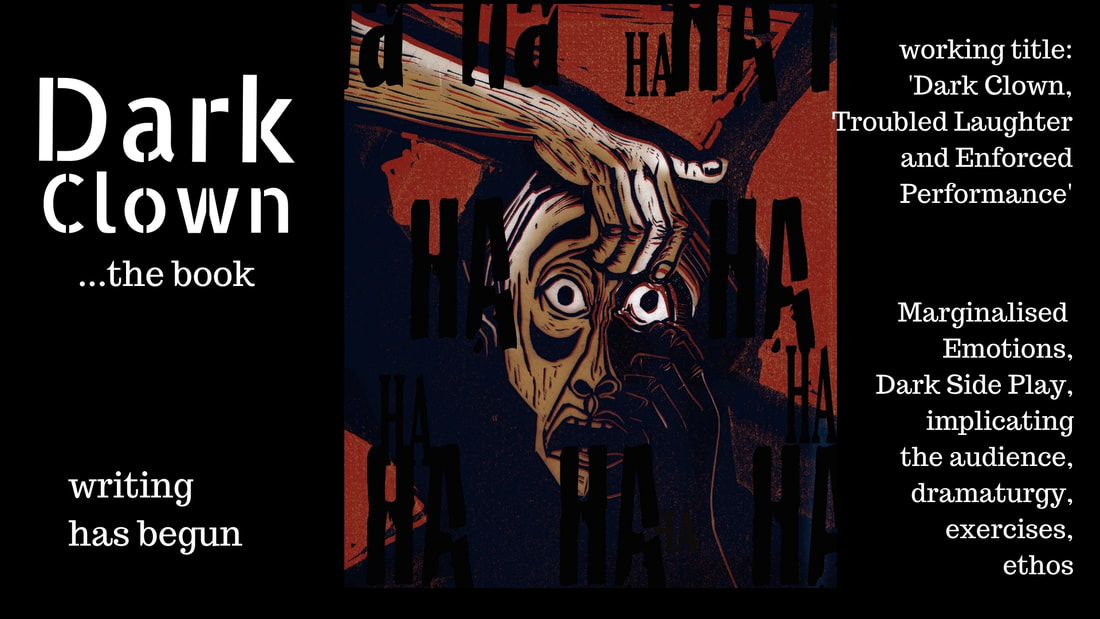
Work on the book has begun - I will be writing the book throughout this year.
|
Work on the book has begun - I will be writing the book throughout this year.
0 Comments
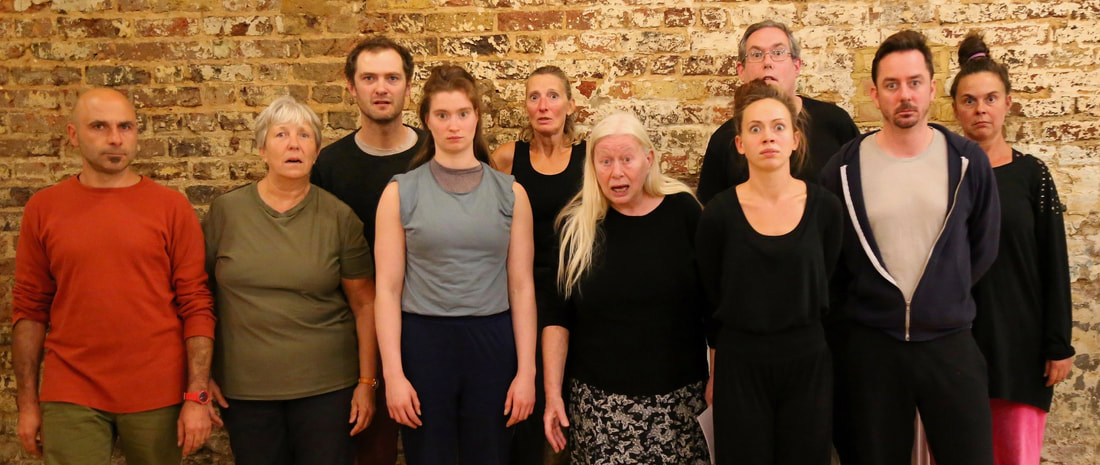 Dark Clown is a unique body of work - it's a chance to explore a vital and compelling performance style, a chance to explore the edges of laughter...and more. It's a space to grow your confidence working in a wider emotional range, to learn comedy craft and/or to more deeply install comedy skills so that your other performance work can flourish. It's place to open your flexibility as a performer, and give your imagination a workout. It's place to finesse or grow audience skills - engaging, compelling and implicating your audiences while learning how to more reliably create laughter and other responses in your audiences. 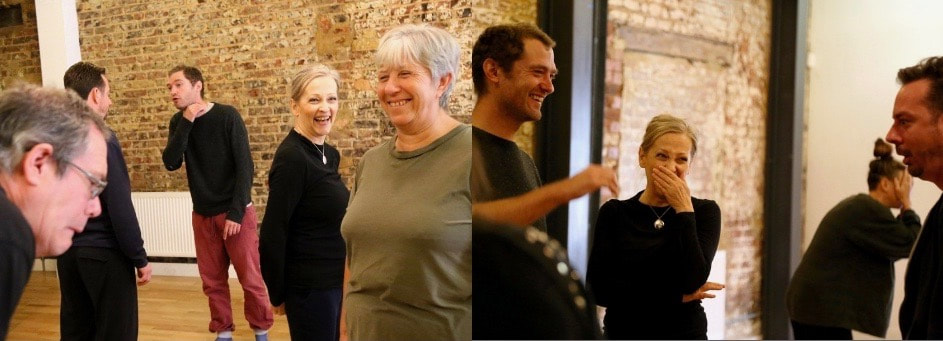 A step-by step approach helps the participant really engage audiences and to develop expertise in the important comedic use of rhythm and comedy craft. We start in Clown mode to build the play and connection in the group, but also importantly in Clown mode we can cover physical, vocal and rhythmic techniques for creating, growing and building laughter. (In order to create the Troubled Laughter of the Dark Clown, we need to be able to create laughter relatively reliably). We then move on to exercises promoting and supporting a portrayal of the Marginalised Emotions. Other exercises grow the particular flavour of audience awareness that supports the Dark Clown work (see Implicating the Audience below). Then we get to layer these elements together. Don't worry about the terms used here - all is revealed and learned experientially step-by-step on the course! Then we turn to the Dark Clown Scenarios. There are a growing number of Scenarios including North Korean Competitive Crying, Consumer Guilt, Body Horror, Makeup Rabbits, Somalian Pirate Hostages, Eco-Horror, The Beloved, Kidrophobia and many more. 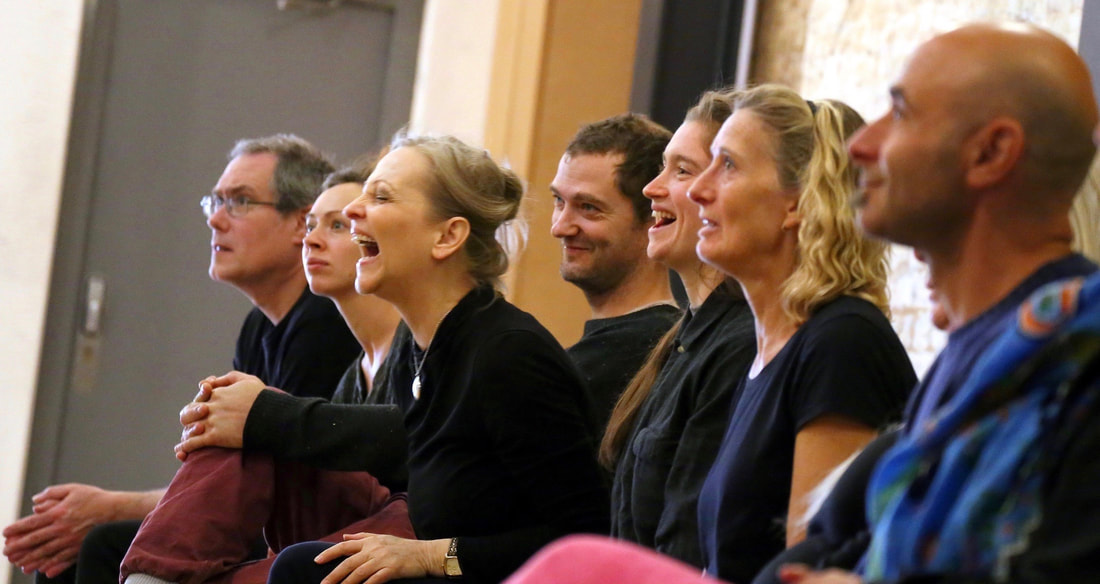 There is a rich range of reactions possible when witnessing the compelling Dark Clown work. 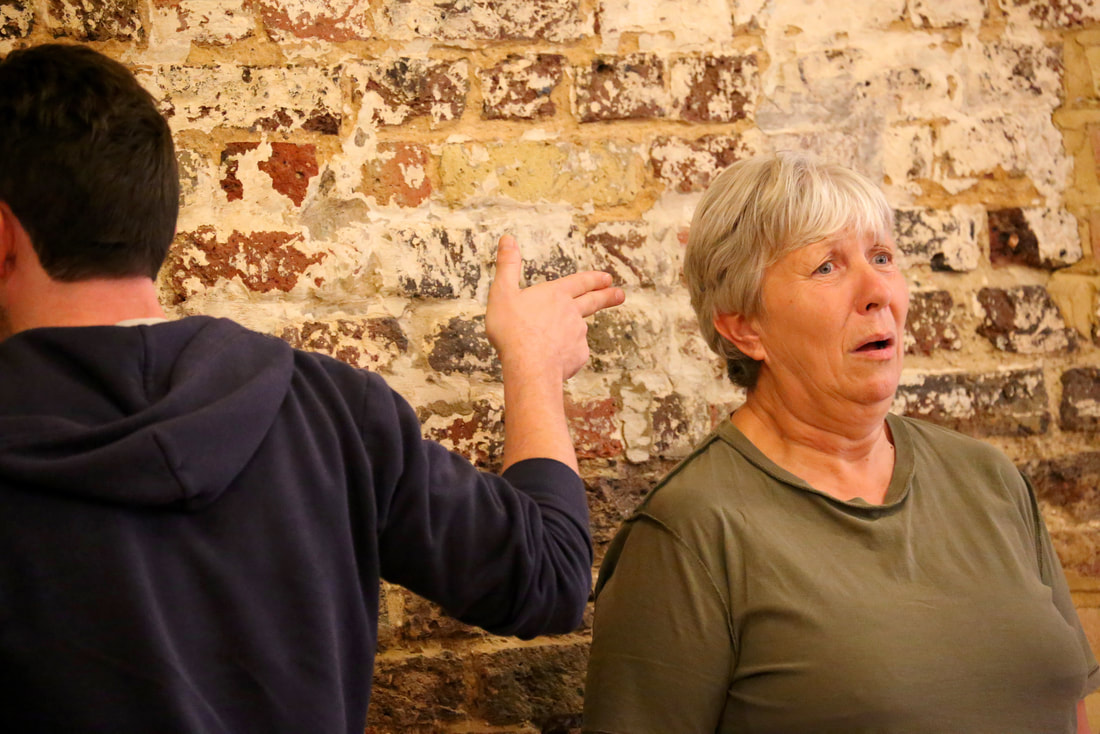 The work is carefully set up in an ethically held space - performers get a chance to invest imaginatively in High Stakes, where energy and expressivity is released. We are aiming for what I call 'Troubled Laughter' in the audience - laughter happens but it is not a laugh at. 'Troubled Laughter' does not trivialise or dismiss the suffering. The performers (course participants) - aim to learn to implicate the audience. Done correctly, the audience laugh in a way that is either troubling or cathartic and often both at the same time. Sometimes they veer between laughter and tears (and occasionally both at the same time). 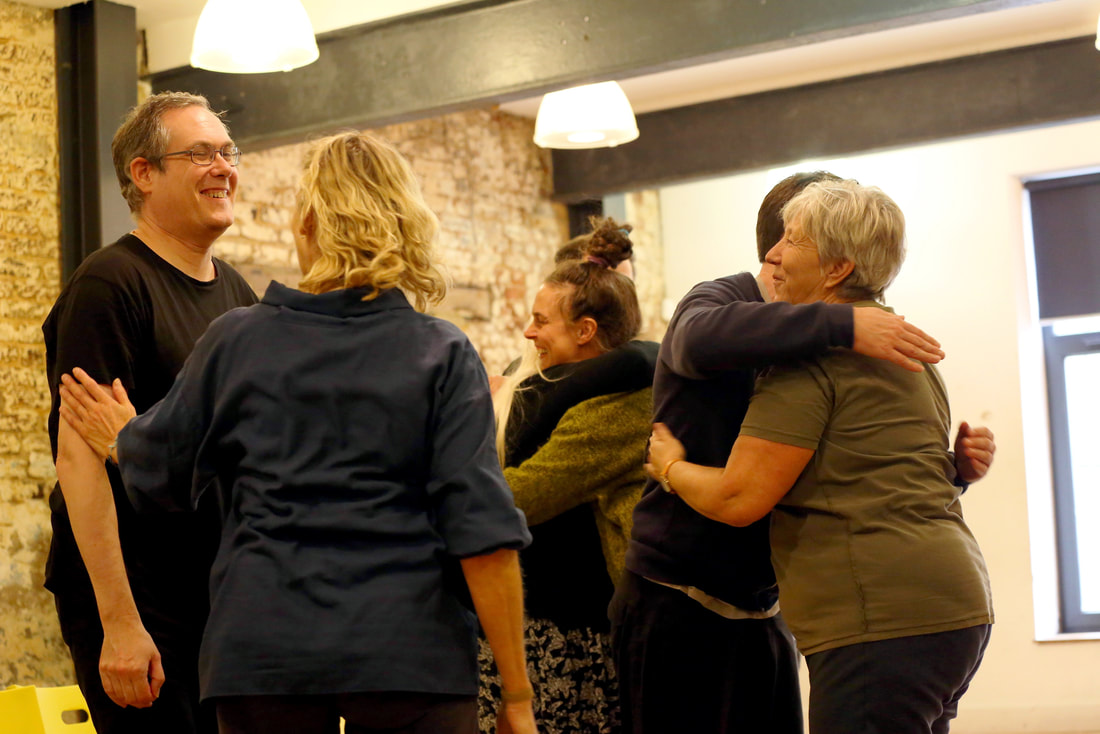 The joy of connection is nurtured during the process. 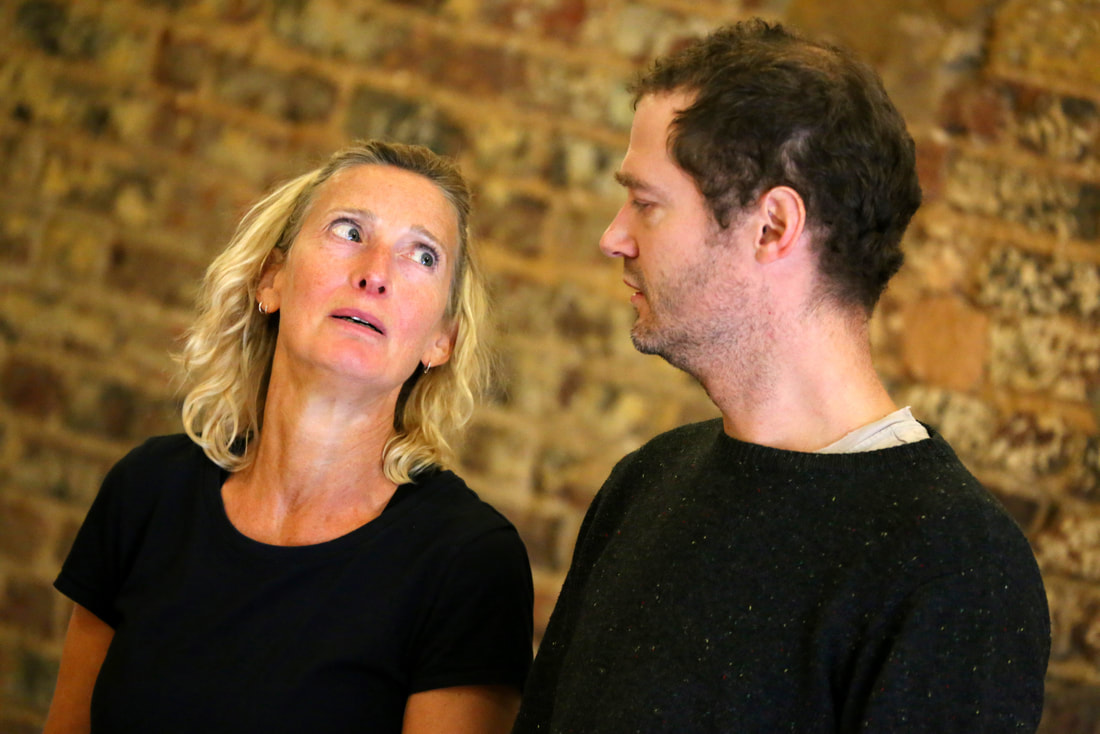 Many return to repeat the course - describing it as 'challenging and rewarding in equal measure'. Maybe also have a look here. 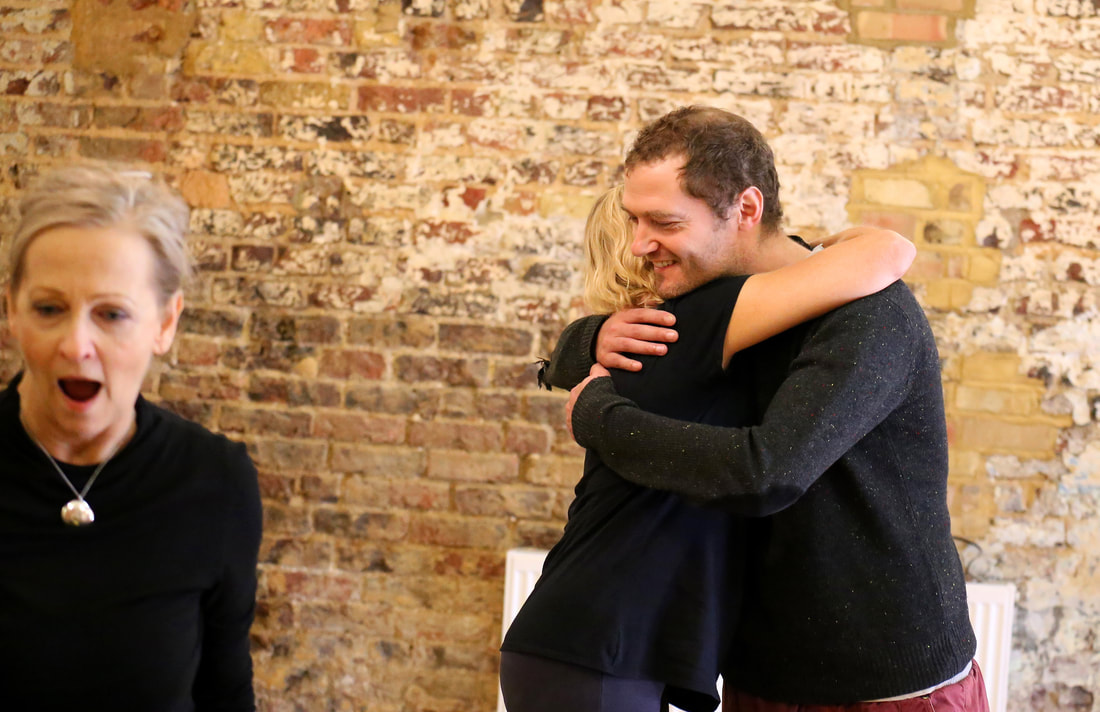 These images by Robert Piwko Photography - highly recommended.
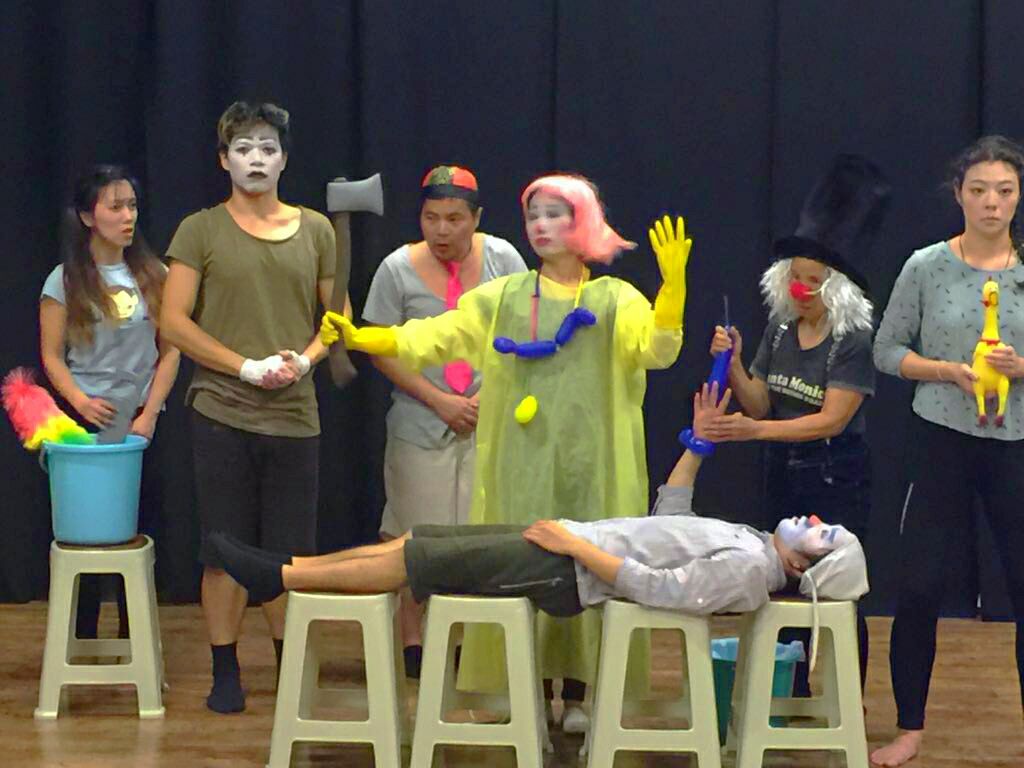 A moment in rehearsal last night - the Surgery scene. Image is either by Cat Lau or Samuel Au-Yueung A productive session last night - making the piece stronger with some excisions and elisions.
Remove that, tighten this. Insert squirty pistol there. One of the cast wrote on Facebook describing this rehearsal period as 'a process of creation and destruction'. I drive them mad with my stipulation for precision. I drive myself mad with my own predilection for detail, multi focus and creating moments of chaos. But things are getting defined. The 'patient' is doing well. Fingers crossed for opening night on Thursday. See other posts on this production here. Look at the show website with more on the backstory and inspiration for the piece here. Currently in Hong Kong, a few days before rehearsal begins on The Death of Fun, the production I will be devising with The Fringe Mime and Movement Laboratory. I am continuing to compile notes and organise my thoughts towards the coming production, which will be (despite the title of this blog post) in the style of Clown, Dark Clown and the Absurd. This show is going to be an experiment, in the same way that the production of Hamlet or Die (produced 2000 for Mime Lab) was. Hamlet or Die was an experiment in whether one could make a full length show in Dark Clown style. The challenge with The Death of Fun, is to make a Clown show about Clowning - or, more specifically addressing some of the recent threats to the art / profession of clowning. You can google 'scary clown' to throw up a number of online articles on this subject. How much of a threat is posed to Clowning by the phenomenon of the Scary Clown (pranksters, thugs and horror films) and by the fact that Coulraphobia (fear of Clowns is on the rise, or has become , as they say, a 'thing' - despite the words Greek roots, it is a neologism, circa 1980's). I have been reading and collecting these articles - and was pleased to read this rather wonderfully comprehensive and thoughtful Smithsonian article on the subject today. This post is somewhat undisciplined (it has a split focus). In part it may serve as the first of a series of posts making a rough log of the production process (we'll see whether time allows for both doing and reflection). It's also an informal wondering brought on by working here in Hong Kong. I read some (not yet all) of J Crump's book Chinese Theater in Days of Kublai Khan (Michigan Monographs in Chinese Studies. I wanted to be more informed about Chinese clown heritage (one of the characters in The Death of Fun will be inspired by a comic Chinese performer). It struck me, reading through the scenarios in Crump's book, that there are some similarities between the comic aspects of Chinese Opera and Commedia dell' Arte. Both forms have a 'family' of well-defined / stock character types. Chinese Opera plots are more concerned with historical stories and myths, and seem more devoted to delivering a moral message than Commedia does. The Chou (likeable, foolish characters in Chinese Opera) are given some license to improvise and have comic exchanges using copious puns. I have seen a delicious video where a character meets his own double.* I think Barry Grantham gives, in one of his books, a script where Harlequin meets his twin. Director William Sun creates works putting Chinese Opera and Commedia together I'd love to find someone who has done the due research and writing on all the similarities and differences between these two forms. Googling for books or articles on the subject, I found that a director, William Sun, worked with the Shangai Theatre Academy to create a fusion of Chinese Opera and Commedia. You can see a youtube clip where he speaks about it here. Western Clown and Chinese Clown And to continued to be undisciplined / split focus - while thinking of similarities and differences - it's interesting that while the Western clown is most usually signified by a red nose, the defining characteristic of the Chinese clown's makeup is a small patch of white around the nose. In Chinese culture, apparently this represents either a mean or secretive nature or a quick wit. * the clip is 'The True and the Fake Wu Dalang' - first he gives a clever story with lots of rhythmic repetition, introduces himself, then at about 2.56 he meets his twin. Check the demanding skill to play the whole thing crouched! Thanks to my friend Yang Wei Wei for her translation. 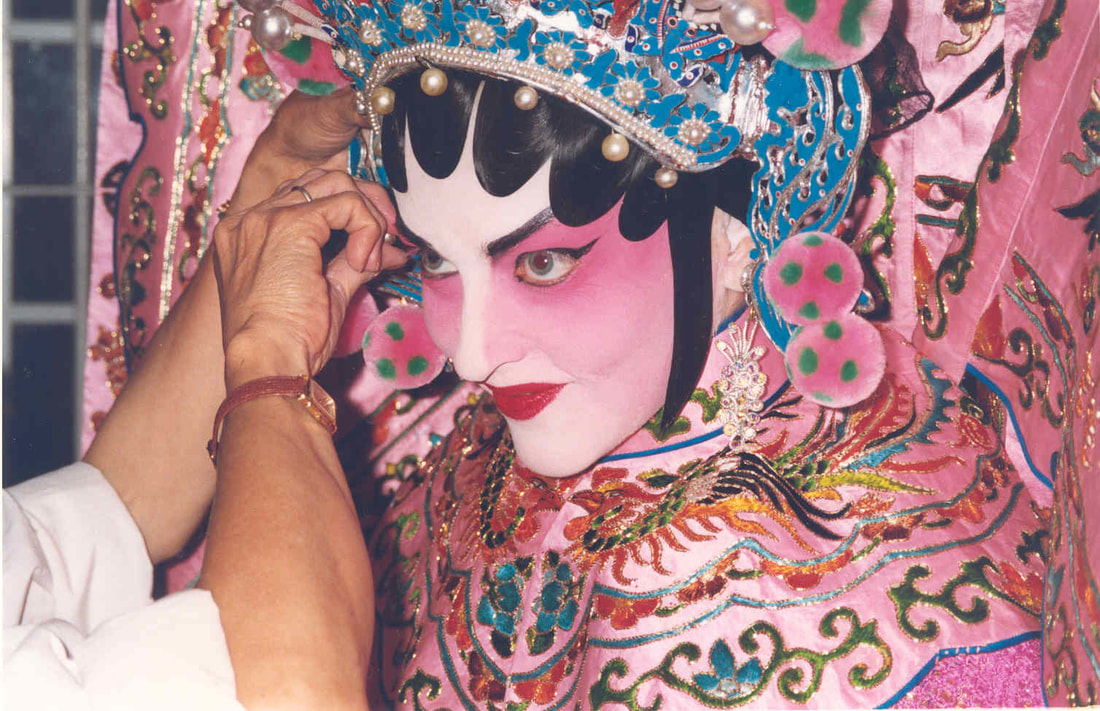 Yup, it's me. Circa 1994/1995 on a previous visit to Hong Kong when I attended (with great gratitude and humility - the work is so detailed and demanding) workshops with Cantonese Opera Performer Master Yung Kim Wah, culminating in the privilege to undergo the full costume experience - wig, makeup and then costume. It took hours. This is not a comic character, but the Female Warrior or General. 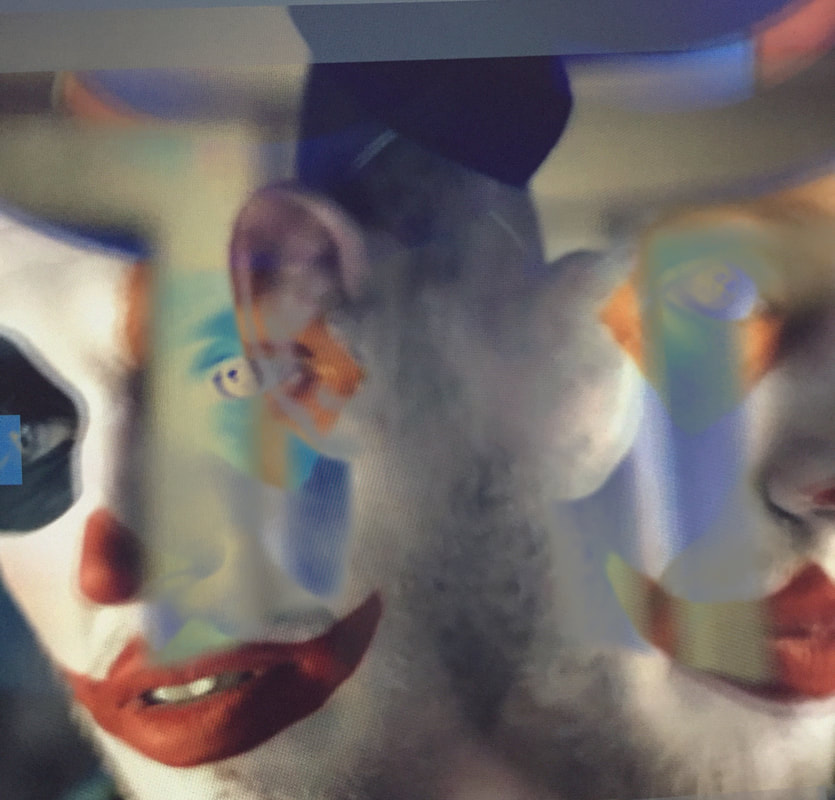 photocollage - using images shot from the TV screen during Grayson Perry's series on manhood (this is a cage fighter who dresses himself as a clown) photocollage - using images shot from the TV screen during Grayson Perry's series on manhood (this is a cage fighter who dresses himself as a clown) The Fringe Mime and Movement Laboratory are a small and enduring company of mime-trained practitioners based in Hong Kong, about to celebrate their 30 year anniversary.
Mime Lab, (as they are know for short) have mounted shows directed by the highly respected veteran mime /physical theatre practitioner David Glass, and also invited me to direct them a number of times. In 2000, they were courageous enough to invite me to create a show for them in Dark Clown: Hamlet or Die. (Audiences were, in the main, shell-shocked: ‘Electrifying…It set a new benchmark for me’ ; ‘hilarious and disturbing’ ; ‘troubling and powerful ; ‘it was very good….ruined my Friday evening’ ; ‘full of power and commitment’ ; ‘wonderful and awful’ ; ‘I sang along with the prison guard and afterwards I felt so small’ ; ‘we felt so totally implicated and yet none of us got up to leave’ ; ‘horrifically, hilariously fascinating!’) It allowed my thinking and teaching of the body of work I was developing under the title of Dark Clown to develop to a new level. Mime Lab have invited me back to direct a new piece. I knew I wanted to do something on the seeming rise of phobia about clowns. Also to deal with the hijacking of clowns by thugs. And the sorry fact that daily in satirical cartoons and Facebook posts the word 'clown' is bandied about as an insult. And it's unsettling to see some people in positions of responsibility adopting an air of bluster and rascality as a kind of misdirection - i.e the ex-Lord Mayor seems to want to give a message : 'I am harmless, forgivable'. To make a lame joke - it's giving clowns a bad name. But of course, it's more complicated than that. Not all clowns are sweet - they unsettle, their have their roots in the tricksters of ancient times - deceivers, mischief-makers, creators of chaos (for example the Norse god, Loki). Many have written on this subject, and spoken on it. You can check out the Clown Symposiums held by Bim Mason*. Here is what I wrote a while ago as a short mission statement/preliminary vision' to myself: Coulraphobia (fear of clowns) is on the rise. Who is at risk? What is at risk? When is funny heartwarming and when is it threatening? Can you venture to the Uncanny Valley and survive? If horror movies make us fear clowns, then who do clowns fear? Thugs masquerade as clowns. McDonald’s ‘enslave’ a clown. Politicians are colonising nonsense. When chaos and unpredictability is everywhere – what happens to the clown? And what happens to the human heart? And if clowns were to rebel – would they resort to mischief or mayhem? Grateful to Mime Lab and also grateful to fellow theatre practitioners and other valued friends who took time time today to reply to my request for feedback on copy towards advertising the show. I knew 'Coulraphobia' would not work for the piece as show title in English or in Cantonese. Mime Lab delighted me with the title: The Death of Fun’ Chinese Title: 樂於嚇人 (translates as 'Pleasure to Scare You'). A journalist friend supplied finessing and a satisfying last line for the brief poster copy: The Death of Fun What would life be like without laughter? The clowns of the world are worried. No one is taking them seriously... Horror meets humour - but the absurd has the last laugh. A fellow theatre practitioner challenged the 'mission statement' above: '...too many big questions. They're all valid but they feel disconnected: is it about what the clowns fear? is it about them being annoyed that thugs, politicians and mcdonald's give them a bad name by masquarading as clowns? Who is going to the Uncanny Valley? Also some questions feel like they could relate to the show and others like they're a commentary on the outside world. How do the two fit together? I can see that there are strands inspiring my original thinking e.g. Uncanny Valley and allusion to political events and corporate power which will serve better as driving the spirit of the piece (external context rather than overt content). I am aiming to explore: ...a kind of ‘Huis Clos’ for Clowns – an assortment of clowns find themselves gathered together in an unspecified location. A mime clown, a Chaplin lookalike, a Cantonese Opera Clown, a scary masked clown, a traditional western circus clown. Are they here for a celebration, for an audition, for a funeral, for questioning? Or worse? They find themselves compelled to perform: acrobatics, plate spinning, balloon animals. What if they fail? Existential problem – Clowns are born to fail. And if Failure is not an option what is the appropriate punishment? Surgical removal of the Funny Bone? *Bim Mason’s Clown Power Symposium 2017 1/ https://vimeo.com/202070978 2/ https://vimeo.com/203435027 (you can also see Bim Mason’s Clown Power Symposium 2016 – where I spoke about my Dark Clown work https://vimeo.com/143601205) I was fortunate enough to meet Dave Pickering at a Devoted & Disgruntled event on the topic of Gender last year. After developing my show Chastity Belt (2011-2013 and still touring), my thoughts were stimulated by wider questions of gender and associated issues. I got an opportunity to see Dave's show Mansplaining Masculinity which I found thrilling, informative and thought provoking. Dave interviewed me the other week for his Getting Better Acquainted podcast and it's fresh up today. He is such a warm, informed and generous interviewer and runs his podcasts like a conversation. On twitter today, Dave (his twitter handle is @goosefat101) summed up what we covered as we spoke : In @GBApodcast 288 @peta_lily talks movement, memory, memoir, dark clown, solo shows, bereavement and so much more. And here now is the link to all of that on soundcloud.  Dave Pickering 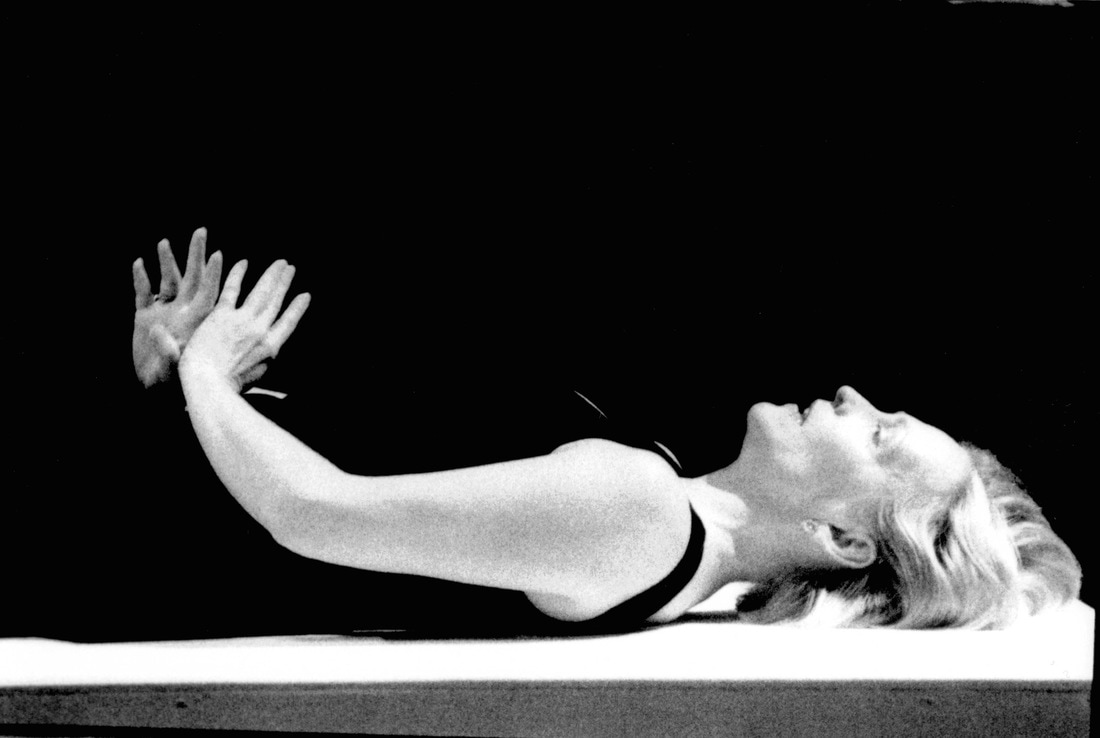 Image from Midriff (centre piece of the Trilogy) circa 2002 Photo: Esvigo 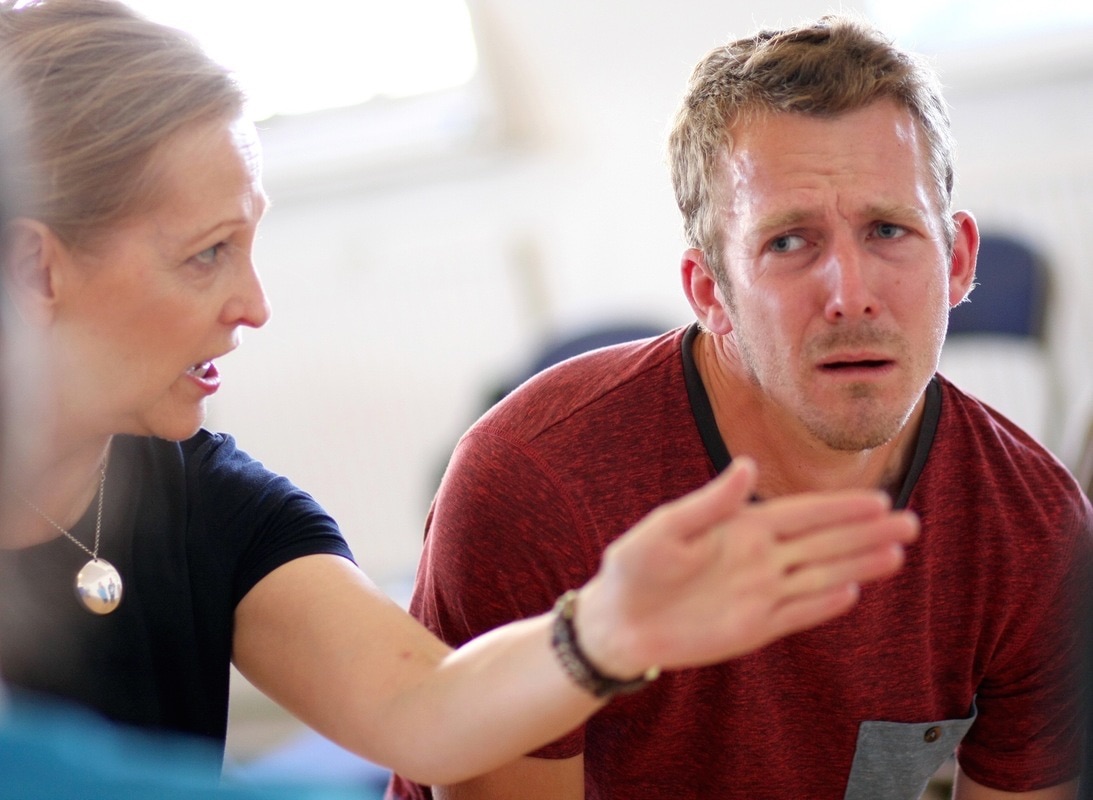 teaching Clown & Dark Clown on one of my two-day open courses. Photography: Robert Piwko Comedy = Truth + Pain*
Dark Clown helps Clown Doctors - who knew? When I went to work with the Clown Doctors of the Theodora Foundation in January 2013, I had one of those 3am-in-the-morning experiences of waking bolt upright and worrying: why am I bringing a clown style based on troubled laughter to children suffering from illness and undergoing invasive and painful treatments? I knew that the Clown Doctors themselves would benefit from the work because many actors, performers and clown practitioners have found that the Clown & Dark Clown workshop has helped; open their imaginations and understanding, stretch their emotional range and refresh their practice. The workshops were received well and afterwards I received this message from one of the Clown Doctors in Belgium: "Your workshop about the Dark Clown is alive and kicking with us. In hospital situations we have used it already. As we go to an older child, we say: ‘sorry for being to late, we are a lot too late, years too late’ and then we beg them to forgive us... And then there was one boy who was upset that he couldn't eat before his operation and was all the time asking for food. So we became mad and demanded food, and wanted to eat everything in the room, and we captured his attention. He said suddenly...’but you cannot eat that!!’ “ I see this as evidence of the catharsis I feel the Dark Clown can provide. And of the value of including a darker spectrum of expression into one's clowning. Not wanting to simply 'cheer up' the patient, but joining them a little where their pain lies and allowing them to feel the same liberation we feel when watching the Red Nose Clown receive pain for our pleasure. I recently received another message from a Clown Doctor who did a workshop with me in 2016: “The Dark Clown work is definitely useful for hospital clowning. We need to have the courage to play a wide variety of emotion. Using aspects of the Dark Clown training, as we work, I can see the opportunity to empower children. We can reflect them back in clown play and so relate to / support them in their more difficult emotional expressions. Often children are constrained by parents who want their children to only be nice with the Hospital Clowns.” – Marieke Bohne, Clown Doctor * This useful nugget comes from John Vorhaus’ book The Comic Toolbox: How to Be Funny Even If You’re Not. 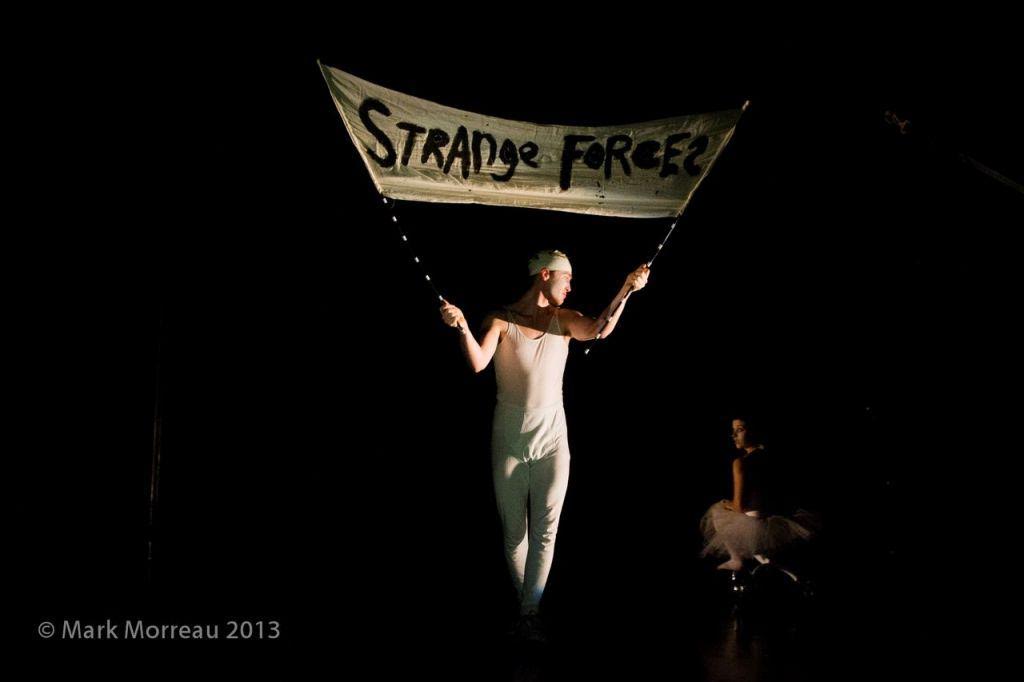 Designer Andie Scott recently interviewed me about how I collaborated with her on the design elements of various shows. We also mention work created with designer Nadia Malik. Andie = AS My responses = PL AS: In your direction for the linking pieces for Strange Forces at the National Centre for Circus Arts the rehearsal notes call for additional props each day. In what way do these props help you devise the performance? PL: The props help define the world and they also help actions be more specific. For comedy, specificity is good – one of the prime comedic principles is clarity: when we know what is going on then we all can get the joke. They are also the product of play or a playful state of mind. With the ensemble element of Strange Forces we were creating a fantasy world: Slave Clowns having to stage-manage the main acts of the show. It is a joy as a comedy practitioner to have polished, specifically made or chosen articles. In one scene a prop piece creates the illusion of a tiny man who is to be tortured by tickling. We needed a small red tickling brush. A longish handle as it is an implement for the normal-sized tormentor, and then a tiny tuft of red feathers at the end, to target the little man’s vulnerable spots. 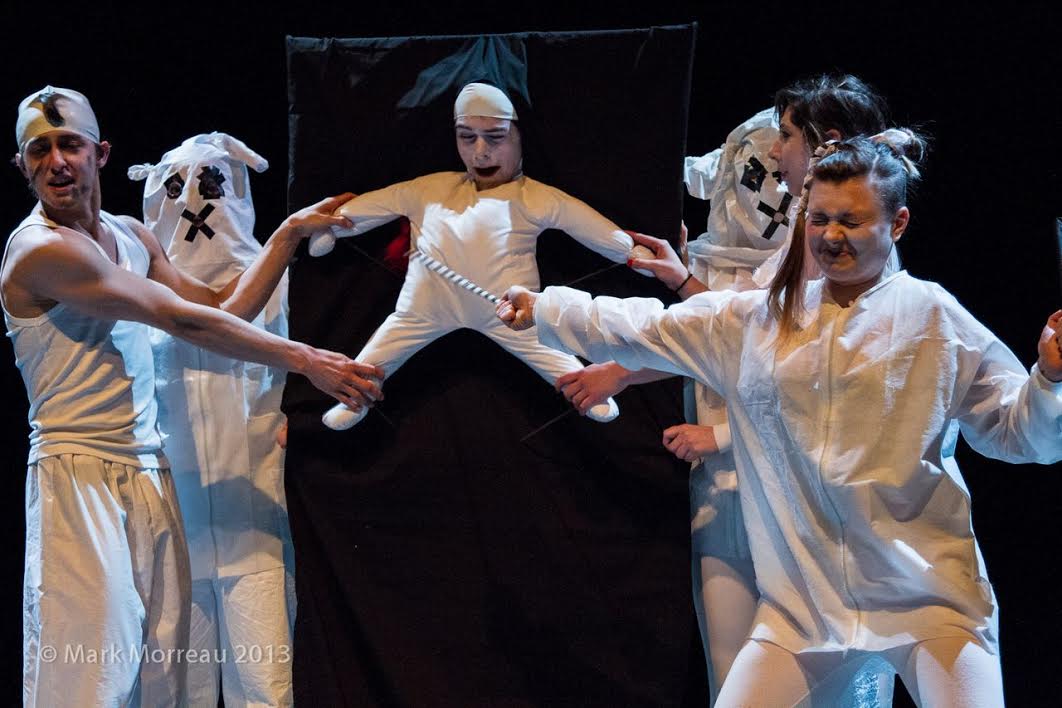 The props in Strange Forces added concreteness and detail to the world. An audience member can have great pleasure looking at a well-made and well-envisaged prop. I believe that comedy should provide ‘entertainment per square inch’. The more moments of joy or energy there are, the more the audience’s imagination, physiology and breath are kept in a good laugh-ready state. I call it ‘priming the laughing gear’ (i.e. the eyes, breath/lungs, mouth corners, skin resistance) the more charmed and primed an audience, the greater the pay-off come the key laughter points. If a talented performer is given a prop they might invent a further bit of business with it. This could be an extension of the original idea or simply an entertaining flourish. Good collaboration can expand possibilities, too. I wanted Pussy Riot masks in the show. The soundscape artist, when asked to source a Pussy Riot song said: ‘They can free the slaves!’ And so we created that scene of the liberation of the slave clowns. AS: Often these props become costume elements and personify the characters. How do you visualise this to enable you to be specific about the props / costume required? PL: In Strange Forces, again I think about the ‘little man’. The audience really identified and connected with this character. Here, I was using a prop piece used in vaudeville (a screen with a hole for a face and then and a manipulatable puppet body underneath), I’d also used this idea a few years back in a show about Brecht in Portugal, where we adapted the The Baden-Baden Lesson on Consent. The safety goggles for the unicorn tamer were pragmatic in that they are given to NCCA students to wear when training with whips. This prop/costume piece reinforced the world the piece was set in (the pragmatic functionary garb worn by the ‘slave clowns’ - which in the main was white paper painting-and-decorating suits (which also summoned up chem-hazard resonances). In terms of the performer/character wearing the goggles, they reinforced both her lack of mastery and her vulnerability - the piece was about people being forced to do things that were dangerous. She looked simultaneously more vulnerable and more dangerous. 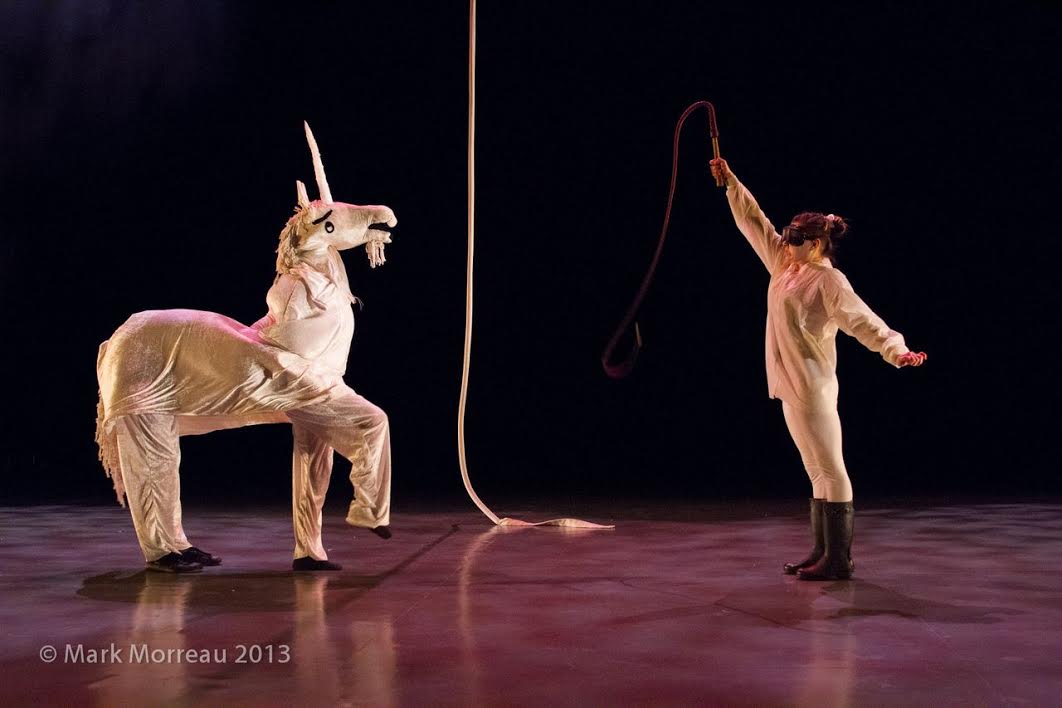 In Hong Kong in 2000 I created a Dark Clown show – called Hamlet or Die. The prisoners in this piece wore striped outfits and had numbers on them – this must have stuck in my head from seeing footage of the dance marathons in America in the 1930’s. In Hong Kong there was an extra amplification to this prop/costume element. In Cantonese, numbers are puns and slang. One prisoner was ironically ‘lucky’ 8. Another character was 888 – even more unfortunate! The numbers of the two characters playing Rosencrantz and Guildenstern were puns for ‘spies’. The Hong Kong cast chose witty numbers for each character. A lot of things I visualize come to me straight from the intuition. Other things I think – how can the idea be clarified here? What do the audience need to feel and understand? I talk and think this through with my collaborators. There is a moment when two clown slaves shock each other using a prop which is basically a red emergency button. Andie made clown wigs out of coloured scourer pads. The jolly traditional clown look allowed audience to laugh more freely at their fear and reaction to the electric shocks. One scene change in Strange Forces meant that the floor had to be wiped – to build the reality of the cringing clown slaves, I had them feverishly scrub the stage. A tussle over the wiping cloth ensued and one clown was reduced to using her own body as a dust cloth. Andie brought this idea to a fuller realisation by creating a ‘dress’ out of a length of dishcloth tube which that performer wore in this scene. You can now see segments of Strange Forces on the Peta Lily Company YouTube Channel. At the top of the show we created a drab and desperate little circus parade – we had our safety-goggle wearing lion tamer so one performer was ‘forced’ (in the reality of the slave clown world) to play the lion. This needed to be in the spirit of the ‘make-do’ and utilitarian look of the clowns and Andie created a mane for the lion using perhaps a dish mop sewn into an easy-to-put-on-and-take-off bonnet. Good costume construction means there can be more variety and changes in a piece. Andie Scott also worked for me on a circus hybrid show Rhythm Town. The diversly skilled performers needed a world to marry their different performance styles and skills together. The company became a ‘travelling troupe’ in a retro-themed world (train travel rather than jet), employing suitcases and a steamer trunk with vintage travel labels. A basket ball was being used for percussive juggling and I requested it be painted like a globe. This both served the theme of the piece and harmonized with the world music used in the show. It turned a banal prop into something clever, that reinforced the detail and magic of the world. One section in the original show was an extended piece of music with a train rhythm – we introduced a bit more magic by changing the scale - introducing a toy train to travel across the tap table and performer’s bodies. The props and costumes in this show allowed the show define a world alive so the performers could concentrate on their skills rather working as actors might to create the detail of the world of a play. AS: In Strange Forces for NCCA we worked with very simple costume of white 'slave clown' attire using the cheapest possible materials: paper plates for ruffs, disposable overalls for clown suits, disposable shoe covers for hats and wigs... These costumes made the characters appear vulnerable and fragile. How do you convey these intentions to the performers during rehearsals? PL: I inducted the performers to the Dark Clown genre I have been developing over the last 30 years. This work extends Red Nose Clown work into a darker palette, a darker spectrum of human existence and expression. The Red Nose Clown fails and suffers indignities and so does the Dark Clown – but on the darker side, the portrayal of suffering is cleverly designed to have an implicating effect on the audience. It aims at laughter flavoured with a cringe of culpability. There was a strong start to the show where one clown drags on all the rest tied together in an aerial rope. One clown passes out before they are funny across the stage. This set up the game very clearly for both performers and audience – these slave clowns are being worked almost to the point of death. Carrying on regardless is imperative. (One of the inspirations for my Dark Clown work was Jane Fonda’s character in the film They Shoot Horses Don’t They? – set in the Great Depression where she continues to dance with her dead partner rather than lose her chance to stay in the Dance Marathon (even if she didn’t win, being in the competition ensured the character regular food as opposed to starvation). The students learned the style and were supported in their portrayals as a troupe of slaves by the largely monochrome yet individual looks Andie developed for each of them in the show. AS: In Chastity Belt and InVocation props become part of the costume, to be added to the body and removed according to the story. When the body is not present in those objects you use them as part of scenography. In what way do these objects change once they have been part of the narrative? 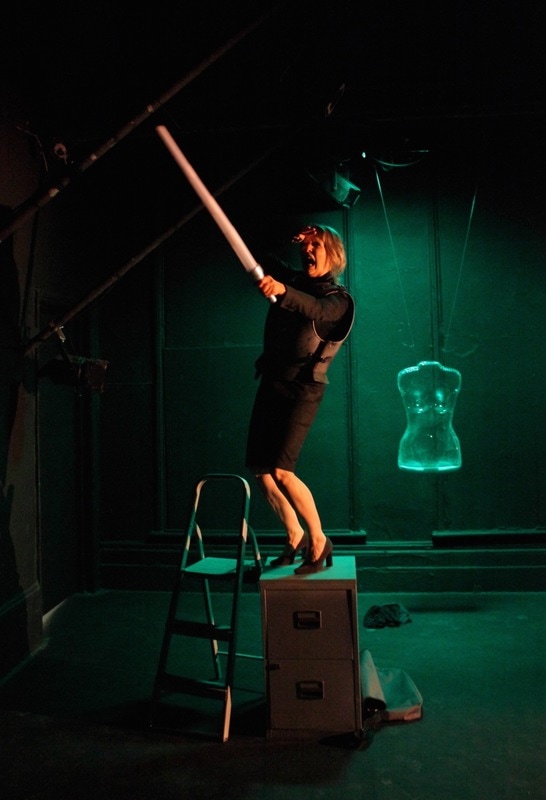 'InVocation' original design Nadia Malik with design updates by Andie Scott. Photo: Nick Cowell In InVocation, the armour breast plate is at first hidden, then worn, then taken off, then used to represent an ‘armoured’ male business coach character. This piece was all about me wrestling against the win/lose mentality in patriarchy’s vision of success. You can watch the trailer for InVocation on the Peta Lily Company YouTube Channel. In Chastity Belt I use a hand-made prop (creating work on no funding): lemons on a piece of ribbon. These are at first a hag’s dugs, then become ersatz testicles, then Wonder Woman’s cape and lariat. My director Di Sherlock is very good at saying ‘use the such and such again in this moment’. It makes things more concrete and visually engaging and appealing for the audience. The yellow marigold gloves are only used in the Lysistrata piece but are one of the splashes of yellow about the spare stage ‘set’. The lemon garland dresses the chair, then is worn in different ways to represent two different characters. When a piece is removed and discarded, it helps underline or highlight a transition point. At a certain point the piece required a Kali necklace and I commissioned Andie to fabricate it – I would never have been able to make it. Andie ensured it was durable and good looking and that it resonated with the props I had already. 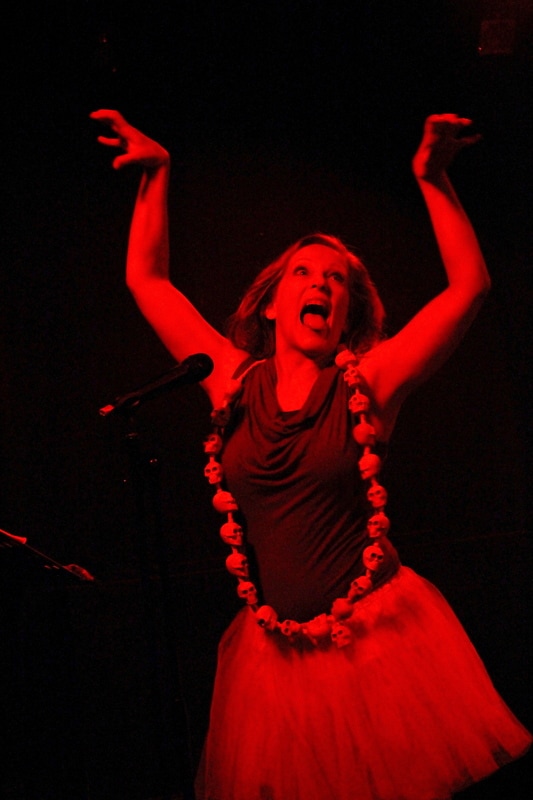 Andie Scott's Kali necklace in 'Chastity Belt'. Photo: Robert Piwko AS: Your performances offer insight and identity with the relationship between fragility and a masculine world yet allows many men access to it and to empathise. You achieve this through the humour of the dark clown - a genre which you are synonymous with - How do you identify your work within a historical context of male clowns such as Grimaldi, Chaplin and the Marx brothers?
I suppose every western clown follows in that lineage. As women perhaps the journey is less straightforward. It is quite possible that some female clowns have been swallowed by history – performers like mime/dancer Trudi Schoop. There seem to be no female clown archetypes like the Auguste and the circus White Clown. The lineage is patchy. When I studied Commedia dell’ Arte, the main exploration was understandably with the mask work and little guidance was given for the female characters of Columbina and Harlequina. I seens to be that female performers such as like Lucille Ball and Phyliss Diller used a kind of clown in sit-com and standup formats. Interesting to observe that some female clown performers often dress in male attire: Angela de Castro, Nola Rae, Guiletta Masina in Fellini’s La Strada. When I started the company Three Women together with Claudia Prietzel and Tessa Schneideman in 1980, I was inspired to create a style of mime that was not presenting the archetypal ‘everyman’ but which instead showed the pain and ridiculousness of aspects of being female. We had a piece about putting on makeup, a piece about women and their handbags and what was inside them, and we created a clown-like circus using solely household items e.g. an old-fashioned handle-operated eggbeater became a unicycle, a rolling pin was weight-lifted by a strong(wo)man and an old fashioned hairdryer with hood was used as a mask to create an elephant and so on. I started to teach clown decades ago because a female theatre company begged me to teach them. They said they wanted to know how women could become clowns. I remember at this time, people actually had conversations about whether or not women could be funny. I teach and direct in the Dark Clown genre but have not performed in this style – yet. I hope one day to create a piece where I do that. Someone once described Chastity Belt to me as ‘dark’ clowning but for me it is not in the style that I teach and direct as Dark Clown. There are serious points made in the show (moments of bite but with the humour going on around it) – and perhaps that is what that person meant. When I created my show Topless – about breast cancer, lost love and ‘getting things off your chest’ I thought it would only appeal to female audiences, but in the creation of each beat, I had my eye on what would be entertaining, and a strong instinct to avoid sentimentality or self-indulgence. I wanted the show to be funny and entertaining. I knew it needed to capture the attention at the beginning, have a sense of suspense about the outcome and a good finish. When I was small my parents went frequently to vaudeville and the pleasure of those early experiences of silliness and sexiness and a little bit of scariness and skill all performed live must have left a deep impression. AS: Within these themes of loving, fragility and the survivor how does the costume identify your stage personas in Chastity Belt and InVocation for example? PL: From 2002- 2008 I did not perform at all. I made InVocation between 2008 and 2010 and with Chastity Belt it was all still quite new. In the early days when my work was funded I had an aesthetic to have as few props and costumes as possible. Then when I was returning to the field, I was creating work unfunded. As in the early days, a new project always needs to have a photographic image to promote it – often created before the funding is secured. I asked a designer friend if she might be able to loan me a corset for a photo shoot. I thought I would wear a corset and wear boxing gloves. My friend (designer Nadia Malik) could provide no corset but there were two tutus. A red one and a white one and they served very well. It was only on the last outing of the piece that I realized these colours served the passion that was being farewell-ed and the pristine alternative (the silvery autonomous Goddess Diana) that was being embraced. I always thought the tutus were glamorous. My director Di pointed out to me one day that they were clown-like! So there you go – as a mature performer, if you can’t afford glamour, then the clown will serve you well. A bit of tat = the equivalent of Chaplin’s tramp costume? InVocation as a piece had a long gestation. In the creation of the piece I was healing the difficulties of events of the non-performing years…it turned out one of the themes was that of identity. The same theme that pervaded Topless I discovered, only towards the end of creating the piece and realized in fact through the creation of the piece: how do I live now I am divorced, now that I am older? With InVocation I wore rehearsal gear, yoga gear and a business suit (and of course, the breast plate). Nadia Malik had ghostly see-through plastic torsos hanging as part of the set. In the recent remount of InVocation, Andie realized certain new elements to the set and costumes. In the end I strip out of the business suit and what in heck was I going to wear? It was a struggle bravely faced and satisfactorily solved by Andie. What undergarments will suit the older body, not be too revealing, not too unitard-like, not be too sexy, not too unsexy, not too sad-sack looking, not too period-specific. At the end I needed to don the breast plate again - Di wanted me to perform a speech from my play The Porter’s Daughter to highlight my decision to leave business coaching and return to theatre. AS: In your performance of Crystal Lil (costume conceived, designed and made by Nadia Malik; piece directed Anton Mirto as part of the LCF MA Costume and Performance degree course show produced by Donatella Barbieri), the costume becomes an inhabited sculpture. Can you describe how this performance differs from your own work, for example did you feel restricted working within someone else's direction or was this liberating? It was a great process. Director Anton Mirto made a wonderful piece and got a very different performance out of me. She also accepted my moments of collaboration during the process. And both Anton and I were both serving to realize Nadia’s concept and the story she had chosen. The costume needed to be managed well to make the most out of each moment for the character and to clarify what the character was doing. In my 1988 show Wendy Darling I had a plethora of props and before each performance would rehearse carefully each moment of prop manipulation. It’s a skill and a discipline to make your props look magical.  Photos: Robert Piwko Montage: Peta Lily Photos: Robert Piwko Montage: Peta Lily THE COMEDY OF TERRORS - Dark Clown and Enforced Performance
Observations on Dark Clown from the practical research work of director writer performer Peta Lily Based on a talk presented at the LAUGHTER AND TRANSGRESSION SYMPOSIUM at Bath Spa University on the 13th May 2011 (this was an informal Symposium and the paper is written in an oral delivery style) What does she mean, Dark Clown? What does she mean Enforced Performance? All will be revealed. Firstly ‘normal clown’. Historically there have been many kinds of clown, but today most people know and study the Le Coq/Gaulier theatre clown who wears or doesn’t wear the small red mask. This clown is not exclusively so, but tends towards the innocent and the naive. It has no past and next to no memory. As in: 'Wow what a nice shiny red button! bzzt crang ow! (shake of head, double take) Say, what a nice shiny red button! bzzt crang ow! (shake of head, double take) Gosh look at that nice shiny red button. I wonder what it does?......bzzt crang ow! (shake of head, double take).' And we laugh. And we say ‘look at that idiot, s/he’s so stupid!’ Dark Clown provokes a different quality of laughter. Dark Clown is where the audience laugh but at the same time they ask themselves, ‘should I really be laughing at this?!’ It’s a laughter with a different feeling in your chest and your gut. A laughter that at its height, makes you squirm and can include the red cheeks of shame and projectile tears. After a while researching the Dark Clown I began to think how strange it is - that when the Red Nose Clown trips and falls it gives us pleasure. We want him to trip and fall again, and trip and fall again, for our pleasure, until we are bored….and then we want another clown to trip and fall - or do something else for our pleasure. And we feel totally okay about this. (1) But with the Dark Clown, when the audience laughs they feel implicated. To explain my use of the term: Dark Clown. It was a phrase I plucked out of the air to make a distinction from the regular clown work I was teaching. (2) Inspirations for the Dark Clown? Back in the early 1980’s I went to the ICA in London one night to see a production of Pip Simmon’s ‘An Die Musik’ (the title comes from a beautiful German Lieder by Shubert). The piece was set in a prison camp, where the prisoners - musicians and entertainers - are being forced to perform for their captors. But what really was unforgettable was one scene: a man very tall and gangly with a shaved head came forward danced strenuously, desperately looking right at us while simultaneously hitting himself on the head with a metal tea tray. He was singing Hava Nigila, dancing grotesquely and hitting himself on the head repeatedly. It was hilarious and awful, at the same time. I started to add a session on Dark Clown to my Clown workshops. People seemed intrigued and excited by it. We explored extremity. I would ask the performer: could you make us afraid, could you make us afraid that you might hurt yourself, kill yourself, eat yourself? I also explored a kind of cynical clown who has the attitude of contempt, where the performer says or thinks: ‘I knew you’d like that. I knew you’d laugh at that. Is that all it takes?’ And I also explored the idea of existential horror - the horror of being alive. Body Horror - the horror of having body parts. ‘Hand! I have a.. Hand! Why?! Hands?!’ Another source of inspiration was Lumiere and Son’s show Circus Lumiere. In one scene, a big clown uses an electric cattle prod to administer shocks to a small clown – to make us laugh. The more we laugh the more they feel compelled to give and take the shocks. And to turn the dial higher. In the workshops I became more and more compelled by the idea of the dark clown having to make the audience laugh… or else…. so I began to add in the scenario of a torture camp: imagine - people are back there being tortured and then a bell rings they are thrust out onto a brightly lit stage to perform for their captors. This has become for me the most compelling application or flavour of the Dark Clown work I’ve been researching - the scenario of Enforced Performance. This was something real that happened in the concentration camps. Enforced acts of humiliation and confession no doubt happened in Argentinean torture prisons & other places. Human-trafficked prostitutes have to pretend to be happy or other things for their captors and clients and memorably, we saw the staged photo stunts as forcibly performed by the prisoners in Guantanamo Bay. Now this is different because it’s elective, but not so long ago, I glimpsed on television a show called ‘So You Think You Can Dance’. They showed tight close-ups of people being struck off the show. The humiliation, anger and desolation on their faces was being offered up to us as entertainment…. So I want to say here that in both workshops and performance I always set up the Dark Clown work very carefully. (3) The intention is not to ridicule suffering or those enduring suffering, but to offer the watcher the experience of laughing - and feeling troubled by that laughter. Technique The game of tension and release is one of the main components that underpins laughter. As is the game of contrast and surprise. And another key factor in Comedy is the concept of truth plus pain. In the red nose clown the game of tension and release has a bouncy flavour. He will scare and delight the audience with his clumsy attempts to ride a wobbly unicycle. In Red Nose clown training, the teacher will threaten to send off a clown. ‘You’re appalling. Get off!’ The threat of being sent off is aimed to inject more energy into their performance…. Plus it gives them also the opportunity to acknowledge their failure, show us their feelings… We love the clown most when he or she is in deepest in the shit… (4) we enjoy seeing their humanity at that moment. The Red Nose Clown in these moments sells its silliness, its disappointment, its bossiness, its enthusiasm. Dark Clown sells its pain, its humiliation and its anguish. In Dark Clown the stakes need to be high. People in workshops often find it hard to get the right degree of intensity - so I invented the shooting gallery exercise. (5) First I teach a repetitive stamping dance that is slightly difficult to perform. The clowns must perform it together in perfect alignment. It’s a machine to create accidents and mistakes. If someone makes a mistake or is insufficiently invested in the situation (that they are performing under fear of pain and punishment), I ask the workshop participants who are seated, ‘if you had to shoot someone in this lineup who would you shoot?’ Now it’s an amazing (and slightly chilling) thing how quickly people get into this. ‘James is smiling, he’s not taking it seriously. Shoot James.’ ‘Alison looks bolshy. Shoot her in the leg. Shoot her in the knee!’ ‘Shoot the person next to her.’ A useful clowning principle is: ‘If they laughed once, they should laugh again’ (Philippe Gaulier). It’s the Clown’s job to create laughter for the audience. So, if the audience laugh when her arm goes funny, then it’s the performer’s job to produce the same exact sound/shape/rhythm to allow them to laugh again. Then a third time for the rule of three etc. To accelerate the laughter (snowball it), we might even have to shoot her in the arm again. Or in the other arm. And the performer must create a believable verisimilitude of pain and distress. There is an important distinction to be made between Dark Clown and the Grotesque. The Dark Clown performer must be open to showing the cost – delivering to the audience eyes containing a believable verisimilitude of horror, distress, pain, shame, guilt, humiliation or combinations thereof. It is this which keeps the audience implicated, keeps them on the hook. If the performer is somehow taking the pain lightly, or enjoying the shock effect they are having, if we are not seeing the ‘cost’ to them of performing some painful or humiliating action – then there may be a shock laugh but it will not be the troubled laughter this work aims at. The grotesque, I have found, may impact the audience, but falls short of implicating them. The Red Nose Clown is like Wile E Coyote – run them over by a steam roller, they pop right back up… The Dark Clown doesn’t re-inflate after a wounding – they get hurt, they suffer, they bleed and they die. Red Nose is there for the audience, Dark Clown is there because of the audience. Red Nose Clown is desperately trying to stay onstage. Dark Clown is desperately trying to stay alive. Like the Red Nose Clown the Dark Clown does live vividly in the moment - but in a different way she is hyper alert because punishment or pain can come in anyway at any moment for any reason and for no reason. Dark Clown must face horrific uncertainty and impossible choices – psychological torture as well as physical and emotional – think of all the myriad moments when people sold out their relatives and neighbours under torture or under threat of torture – we, as the audience of Dark Clown, get to see that. In the case of the stamping dance - do I hop over or around or on my neighbour in the lineup who has fallen to the floor. Do I try to sing better than my fellow prisoner? Must I continue to dance while that person sobs? All this – done correctly - creates laughter…. Part of this laughter comes from shock and absurdity & the rest comes from a skillful and well-judged use of rhythm and breath…. People who play Dark Clown must finesse their ability to play the game of tension and release because the audience get tired more easily due to the quality of the laughter and because the context is harsh. Moments of silliness (and softer rhythms/textures) must be strategically interspersed to relax the audience. The Dark Clown performer must also be able to access acting skills (specifically, the skills of concentration and imagination): they must scream or cry in a way that is convincing of pain and terror but which is also so strategically rhythmic and musical that it provokes laughter. (At the symposium in Bath there was a moment of audience participation here – call and response laughter, then sobbing, using rhythm and breath.) The importance of rhythm. Now, here’s a thing. You can create laughter over and above content - through rhythm and breath. A good stand-up will say that you have to get your audience into the habit of laughter. For example: ‘Anyone in from Cardiff?’ ‘Yes’. Call and response. I speak and you make a sound, ok? That’s how we’ll proceed. But you see most people don’t know this. People will usually assume they laugh because of content and this is where the ability to implicate comes in – When you – or I - find that we have laughed at something shocking, we question ourselves (those of us who are sane) and we get to confront our own humanity. I suggest that The Dark Clown is useful, because it provides an opportunity for audiences and performers to engage with some of the dark absurdities and obscenities of this world, when drama and sentiment can fall short of touching us. Because - the Holocaust, Pol Pot’s regime in Cambodia, these are horrors of such magnitude and incomprehensibility that we are in danger of numbing out even as we try to contemplate them. Watching that character singing Hava Nigila – doing anything he could to survive, I could both see and squirm at the ghastly subtraction of his dignity. And simultaneously release the pent up energy of my own guilt through this vigorous form of laughter…..which at a physiological level shares something with the act of sobbing. In Practice/Performance In the year 2000 I was asked to create a production in the style of Dark Clown – I created a piece in Hong Kong called Hamlet or Die – where prisoners in a torture regime are compelled to perform Hamlet for their captors. I am going to give now a much abbreviated picture of the show (which includes something of the set up required for an Enforced Performance piece). The audience, on their way into the auditorium, must walk past a small cell-like room where the controller is sitting on the loo smoking his pipe and reading a newspaper. Inside the theatre blacks are stripped out. (The walls of the theatre in Hong Kong were white ceramic tiles - the building used to be a dairy). Over the exit sign a large NO was scrawled and ‘barbed wire’ looped round the door. It’s important that there seems to be no escape. On the stage left wall, a large almost cartoon-like switch to deliver electric shocks. A guard in Wellington boots holds a long piece of rubber tubing as truncheon. When the audience is seated, the controller enters across the stage, up the central aisle and takes his place at a desk specially installed in the audience. He leans fwd and taps on the microphone and he says ‘bring on the clowns.’ The stage has a trap door which is opened. Screams emit. The guard beats the floor with his truncheon. Figures emerge onstage. We witness a ‘warm –up’ consisting of punishing and pointless ‘races’. At a certain point: a drum roll and a small red velvet drape drops…. An announcement : 'For your edification, the sad story of Hamlet - the prince who thought too much. Don't think too much. It can only end badly.' Panic ensues incomprehension at the obscenity of this exercise random acts of physical and mental cruelty are inflicted on the poor prisoners who all throughout are aware of the heartlessness of the audience who continue watching everything that’s happening to them. While the actor invested with the role of Hamlet is being beaten behind the little red drape for his resistance boof ahh boof ahh boof ahh! the Controller takes a moment to come down onto the stage. He sings a cheesy sentimental pop song and gets someone in the audience to sing along into the mike. We applaud the volunteer, the controller takes a bow…. then turns back towards the damaged and shivering prisoners and says ‘See, that’s what the people want, they want to be entertained!’ A Dark Clown show needs to be as funny as it is horrific. I planned the next moment to provoke a gasp of shock, but found the call and response habit was so well-installed that it elicited a burst of laughter. The beaten Hamlet crawls onstage in agony to join the scene where Ophelia is returning her letters. The stage-manager prisoner has had to step in for an irrevocably traumatised young Ophelia… The prisoner playing Polonius sticks his head out from his ‘hiding’ place and angrily prompts Hamlet: ‘answer her, you have a speech here!’ The female stage manager kneels with the text over the supine Hamlet… She strains to hear his response… their faces are close, the moment is quite tender… And Hamlet, with difficulty, raises his head – And coughs blood up onto her face… And the audience laughs. The Controller pats the mic Act 4 Scene 7. Number 338, bring the bucket! Ophelia. Drowns. But Ophelia drowns by accident! (says the translator, prisoner number 338, looking frantically through the book, finger on the page) Controller: 'This is theatre, nothing happens by accident. Drown the girl.' 338, horrified: 'I can’t.' 'Number 338, do you want to take the role?' The guard pushes 338’s head in the bucket. Holds it there. (Pause. She emerges gasping.) 338: ‘No, I do not wish to take the role…’ ‘Act 5 Scene 2. The queen drinks poison.’ The guard grabs Number 269 and a bottle of toilet duck. ‘NO NO! Let me dance for you. Let me do it! I’ll drown the girl.’ The controller returns to the stage: ‘So, how would YOU have it end? Who would you have poisoned, stabbed, drowned? Think about it.... (points at head) but don’t think too much…’ (wags finger) If tragedy offers us pity and fear to heal and cleanse the emotions, perhaps Dark Clown brings horror, shame and shock - to fully encompass the pain of watching, unharmed, the suffering of others. © PETA LiLY May 2011 with revisions and elaborations 17 February 2013 (1) The Red Nose Clown performer must fall so skilfully that no concern of injury enters the audience’s mind. If a clown is dealt a blow, or traps his/her finger, then they must rub the spot or shake the hand. The Red Nose Clown must have an inner predisposition to optimism and recovery and in each moment an opportunity to be ‘born’ again. Comedy is regenerative. Life goes on, unstoppably. It is also useful for the Clown to value the audience’s experience over their own – what I mean by that is - that their sadness or hurt must be delivered to the audience while it’s fresh (because it’s the clown’s job to show its humanity), but the performer clown must be prepared to jettison that emotion when the audience needs something else. The Clown is like a healthy child who drops their ice cream, cries, sees a donkey and is all laughter even as the teardrops sit fat upon their lashes. The Clown needs to be an expert at natural emotional release. (2) Someone mentioned to me when I was preparing this talk in 2011, that Dark Clown is a term already in use with regard to Samuel Beckett’s characters. I am not a skilled academic researcher but so far, I can find no reference to that – if you know about other important usages of Dark Clown, please let me know. Many expect Dark Clown to be Scary Clown, Halloween Clown. There is also what I would call Bad Clown (as in ‘Bad Santa’) – I have not seen them live but the fascinating Australian Clowns Blotto and Whacko seem to be to be well-described this way. (One day I’d like to explore this style of clowning more). Other practitioners may teach or perform other things under the title of Dark Clown. That’s fine. I just want to point out that when I refer to the term here in this paper, I specifically refer to the body or practical research I have been involved in since the 1980’s. (3) In a workshop, I always give a short talk that includes the inspirations for the work, the aims of the work and instructions on what to do in the case of someone becoming upset during the process. I explain upset may occur because a) performers sometimes become upset when shifting into certain emotional territory they have not yet exercised b) something personal might come up – which is pretty much the same as (a) and c) the material is dark – step one is to imaginatively understand the stakes of a life or death scenario sufficiently so that it can be played believably and skillfully. At this point in the process it may happen that there is no laughter – not until the performer adds to this the skills of openness, audience awareness, and laughter creation and control via rhythm, texture, inflection, vocal range, energy management and musicality. A participant recently said, during a class ‘But it’s just horror!’ I replied: ‘Yes, horror, but with the skillful application of rhythm (and use of the ‘rules’ of repetition, contrast and suspension) so as to cause the kind of laughter where the audience laughs and at the same times questions themselves for laughing. That’s the aim.’ (4) Philippe Gaulier, Clown and theatre skills Master, said this, or something like it; ‘We love the clown the most when (s)he has a shit in the pants.’ (5) Please note that this is an exercise not a lazzi. And it’s not how the audience is encouraged or intended to respond in a performance situation. The seated students participate verbally in the decision-making in the interests of understanding the unpredictable and terrifying nature of the ‘world’. The aim of the exercise is to raise the stakes for the performer so they can release into the emotional spectrum of the Dark Clown. General note For me a key distinction is that I am not seeking the grotesque. That is why the Dark Clown performer must be open to showing the cost – delivering to the audience eyes containing a believable verisimilitude of horror, distress, pain, shame, guilt, humiliation or combinations thereof. It is this which keeps the audience implicated, keeps them on the hook. If the performer is somehow taking the pain lightly, or enjoying the shock effect they are having, if we are not seeing the ‘cost’ to them of performing the humiliating or punishing action – then there may be a shock laugh but it will not be the troubled laughter this work aims at. The grotesque, I have found, may impact the audience, but falls short of implicating them. 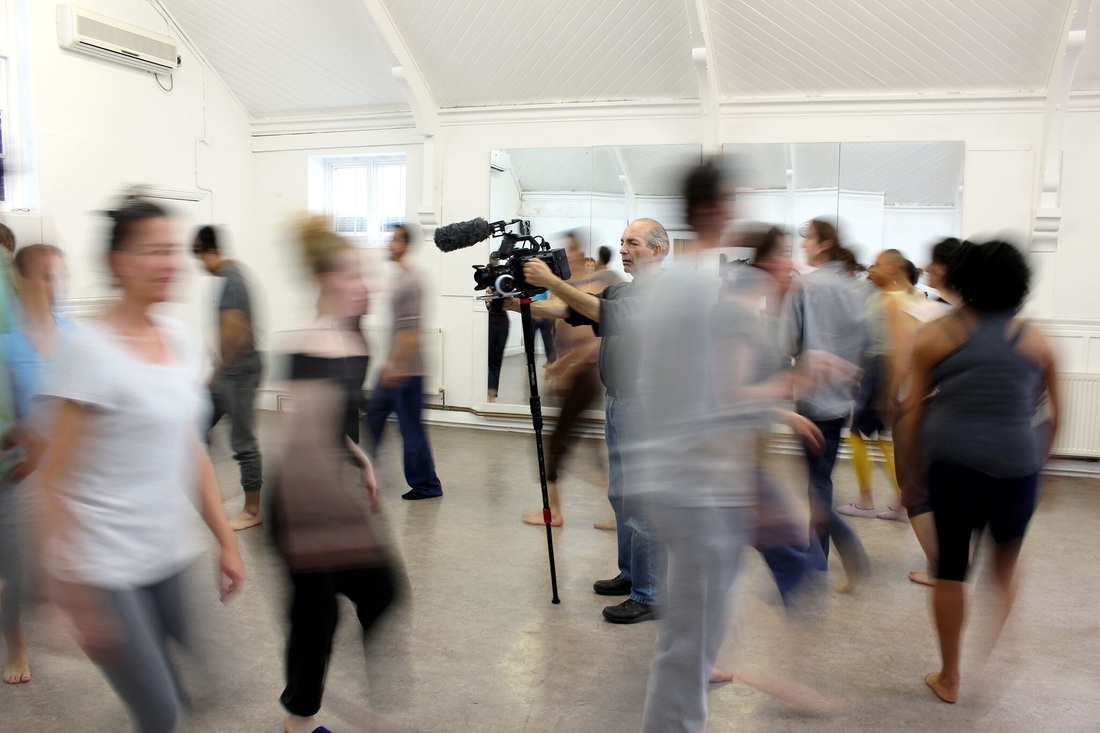 It happened!
A special version of the the Clown and Dark Clown workshop was recently filmed towards a documentary (so far awaiting a title). This image of film-maker Robert Golden capturing the action is by Robert Piwko Photography. This documentary is being made possible by a small but extremely valuable grant from RADA and the CDD. The film is in post production now - there will be more news as it happens. Thanks to the amazing participants - one of whom said: ‘We got through so much with no feel of rush and with very little pain…the seeing and being seen reminders throughout kept me more present than I have been in the past. I felt very safe throughout the two days. I thought you gave a very helpful and reassuring amount of direction, which in turn made a more comfortable environment and therefore better work produced to be learnt from by clown and audience. I found a different kind of stillness within the world of the dark clown. One thought I had was - Being fake happy is awfully depressing, but being fake sad is wonderfully fun.' - Hatty Ashton, Performer |
SEARCH by Category - scroll belowThis blog covers my Clown, Dark Clown, Comedy, and Theatre Making practices. Categories
All
Archives
December 2023
|
workshops & showsJoin Peta Lily Theatre Workshops on Facebook Like Peta Lily Shows on Facebook Follow @peta_lily on Twitter Follow @petalily on Instagram Curious about Dark Clown? get your FREE ebooklet when you sign up to the mailing list - see the form to the right! Something else? If you are looking for a director / creative mentor / workshop leader for a bespoke workshop for your company or organisation or any other matter - go here. * By signing up to the mailing list you agree to receive mailings about workshops, shows, publications and very occasionally other news, usually only about a half dozen mailouts a year. You can always choose to unsubscribe at any time – there is an unsubscribe link to click on in each email I send. Your information will not be shared with any third party. |
|
|
 RSS Feed